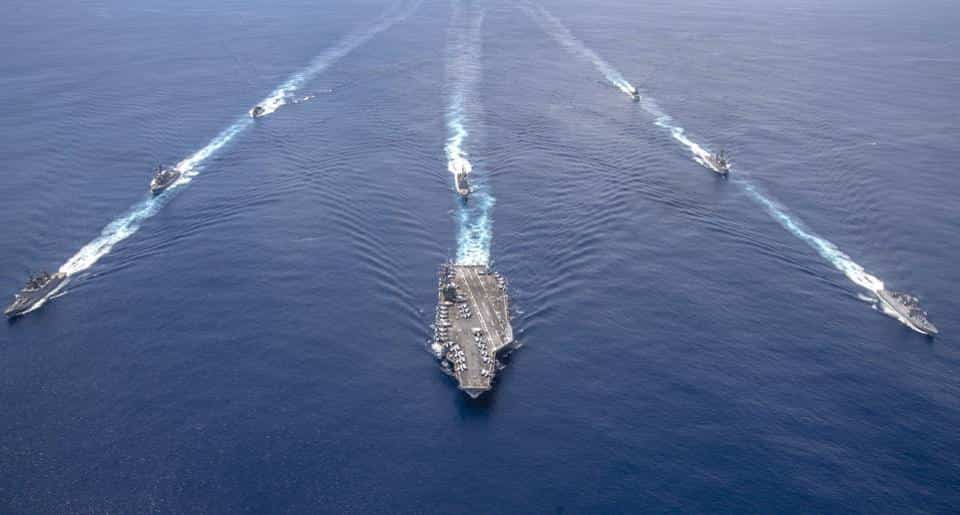
As four Indian naval ships participated in a two-day joint exercise with the American supercarrier USS Nimitz off the Andaman coast this week, another supercarrier USS Ronald Regan teamed up with navies of Australia and Japan to carry out a similar exercise 4,000 km away on the mouth of the contested South China Sea.
The official statements on the exercises did not name China that has been trying to throw its weight around its neighbours. It didn’t have to as the danger is clear and present with Chinese Foreign Minister Wang Yi clearly stating this week that Beijing was moving to the centre of the globe – in effect expounding the Middle Kingdom concept.
The United States has emerged as the bulwark against China in the South China Sea and beyond, deepening partnerships with countries in Asia, Europe and Australia to secure Indo-Pacific from a bellicose China.The two exercises make it evident that India will be the principal ally to US in securing Indian Ocean Region while Japan and Australia will be key to protecting Pacific region.
The message that put China at the centre of the United States’ focus was reinforced by US defence secretary Mark Esper late on Tuesday. Esper explained the presence of the US supercarriers in and around the South China Sea, which irks Beijing, “to back up the sovereignty of friends and partners and to reassure them that we will be there to defend those things” in the face of ‘China’s bad behaviour”.The four navies that participated in this week’s two exercises – US, India, Japan and Australia — would be in the Indian Ocean later in November as part of the expanded Malabar naval exercise led by India. Australia is expected to be formally invited soon to the exercise.
The Nimitz Carrier Strike Group, consisting of flagship USS Nimitz, Ticonderoga-class guided-missile cruiser USS Princeton and the Arleigh Burke-class guided-missile destroyers USS Sterett, and USS Ralph Johnson, along with Indian Navy ships Rana, Sahyardi, Shivalik and Kamorta, steam in formation during a cooperative deployment in the Indian OceanThis would be a QUAD exercise by default,” a military commander said, referring to the four-country Quadrilateral security dialogue or QUAD.
The US, which plays the lead role in QUAD, has become a pivot against China; exercising with the Indian Navy in the Indian Ocean and Japan and Australia in the Philippine Sea near the mouth of the South China Sea.
Mark Esper said the exercise in the Indian Ocean reflects the shared commitment of the US and India to boost naval cooperation in support of a free and open Indo-Pacific.
The exercise with the Indian Navy was conducted beyond the Six Degree channel which separates Great Nicobar from Banda Ache in Indonesia’s Sumatra. The USS Nimitz, which reaches more than 23 stories high from the keel to the top of the mast, was coming down from the South China Sea into the Strait of Malacca.
Simultaneously, USS Ronald Regan conducted the trilateral military exercise as a show of naval might in the Philippine Sea on the doorstep of the disputed South China Sea.
“Throughout the cooperative exercise period, participants will operate and train together, exercising integrated maritime operations in an all-domain warfighting environment,” the US Navy said in a statement, pointing that the exercise would help their response “to any situation”.
China claims much of the neighbouring South China Sea, though the Philippines, Vietnam, Malaysia, Taiwan and Brunei also have overlapping claims in the waters. The US, in a marked change in stance on China’s disputes in the South China Sea, had described Beijing’s pursuit of offshore resources “completely unlawful” and condemned its “campaign of bullying to control” the disputed waters.