
PreetNama
English News

Give him one chance, says mother of Delhi rape convict outside Delhi court

The relatives of the four convicts, on death row in the 2012 Delhi gang rape case, said on Thursday that they are innocent.

“Give him one chance,” said the mother of Mukesh Kumar, adding that she has no one except him. His brother Ram Singh, the prime accused in the case, committed suicide in Tihar Jail in 2013.

The sister of another accused Pawan Gupta also demanded that her brother should not be hanged. “He is innocent,” she told HT.

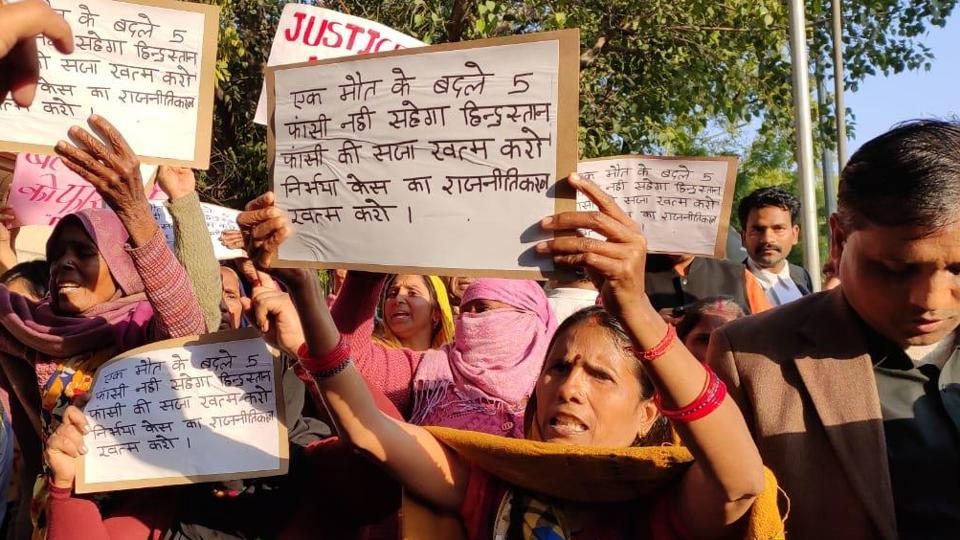
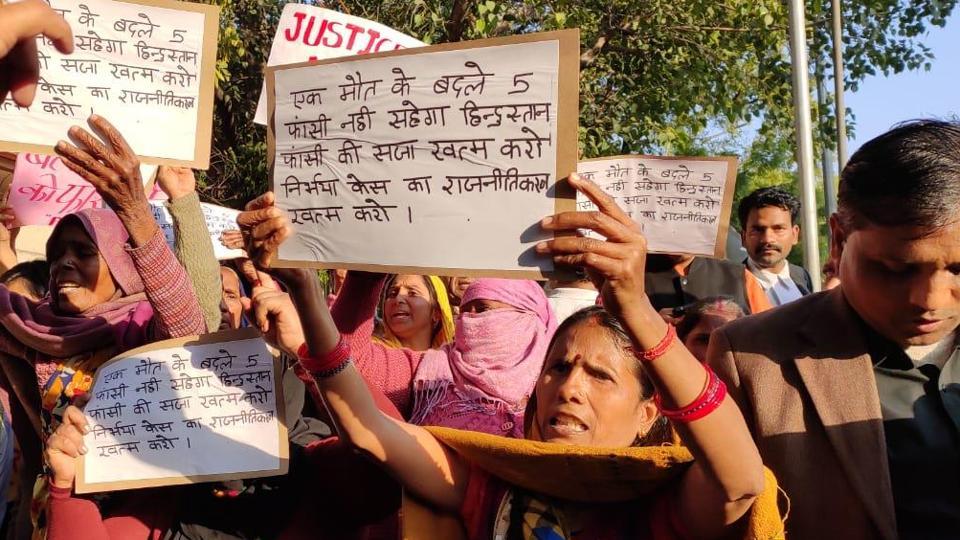
The mother of the third convict Vinay Sharma said that five people cannot be hanged for the death of one person.

The family members were protesting outside the Delhi court which is hearing the petition of the 23-year-old victim’s parents seeking death warrants against the four convicts. The court adjourned the hearing in the case till Monday (February 17) stressing on the rights of the convicts under Article 21 of the Constitution for his decision.

“In my considered opinion, Article 21 of the Constitution protects the life and liberty of a condemned prisoner till his last breath. It is a matter of right to exhaust his legal remedies and the court cannot afford to ignore the fundamental rights of the convict,” said Additional Sessions Judge Dharmender Rana.

He said that deciding this application would lead to further legal complications.

The judge also appointed an advocate to represent Pawan Gupta, one of the four death row convicts in the case, after he refused to take a lawyer offered by the Delhi State Legal Services Authority (DLSA) as legal aid.

The adjournment led to a protest by the victim’s parents outside the court.

The Delhi High Court had on February 5 given a week’s time to them to exhaust all legal options; that period ended on February 12 and the parents moved the trial court after nod from the Supreme Court.

The physiotherapy intern was gang-raped and savagely assaulted on the night of December 16, 2012, in a moving bus in South Delhi. She died of her injuries a fortnight later in a Singapore hospital.

Six people – the four convicts, Ram Singh and a juvenile – were named as accused.

The trial of the five adult men began in a special fast-track court in March 2013.

Ram Singh, the prime accused, committed suicide by hanging himself in Tihar jail days after the trial began. The juvenile, who was said to be the most brutal of the attackers, was put in a correctional home for three years.

He was released in 2015 and sent to an undisclosed location amid concerns over a threat to his life. He, when released, was 20 years old.

Mukesh, Vinay, Akshay and Pawan were sentenced to death in September 2013 by the trial court.
Related posts

Seeking refuge in US, children fleeing danger are expelledWhen officers led them out of a detention facility near the US-Mexico border and onto a bus last month, the 12-year-old from Honduras and his 9-year-old sister believed they were going to a shelter so they could be reunited with their mother in the Midwest. They had been told to sign a paper they thought would tell the shelter they didn’t have the coronavirus, the boy said. The form was in English, a language he and his sister don’t speak. The only thing he recognized was the letters “Covid.” Instead, the bus drove five hours to an airport where the children were told to board a plane. “They lied to us,” he said. “They didn’t tell us we were going back to Honduras.” More than 2,000 unaccompanied children have been expelled since March under an emergency declaration enacted by the Trump administration, which has cited the coronavirus in refusing to provide them protections under federal anti-trafficking and asylum laws. Lawyers and advocates have sharply criticized the administration for using the global pandemic as a pretext to deport children to places of danger. No U.S. agents looked at the video the boy had saved on his cellphone showing a hooded man holding a rifle, saying his name, and threatening to kill him and his sister, weeks after the uncle caring for them was shot dead in June. And even though they were expelled under an emergency declaration citing the virus, they were never tested for COVID-19, the boy said. Three weeks after their uncle was killed, the children fled Honduras, crossing the U.S.-Mexico border alone. Under the normal process set out by U.S. law, they would have been referred to a government facility for youth and eventually placed with their mother. Instead, they were expelled on July 24 after three days in U.S. detention and now live in Honduras with another uncle who is looking to leave the country himself. U.S. Customs and Border Protection declined multiple requests for comment on the boy’s story, and U.S. Immigration and Customs Enforcement also declined, saying the children had been in Border Patrol custody until they boarded a deportation flight operated by ICE. Spokesmen for both agencies have refused to answer most questions about how they treat roughly 70,000 adults and children expelled under the emergency declaration issued in March. They have refused to say how they decide whether to expel children or where to detain them before expulsion, including in hotels where at least 150 unaccompanied children as young as 1 year old have been held. Much of what’s known about expulsions has come from the accounts of children like the 12-year-old boy, who recounted his experience to The Associated Press last week with a recall of details that makes him seem older.

On Punjab

New York nurses sue state, 2 hospitals over ‘inadequate’ coronavirus protection

On Punjab

‘Political game’: China on US Prez Biden’s order to probe into Covid-19 origins

On Punjab